
|
Category: HBPA

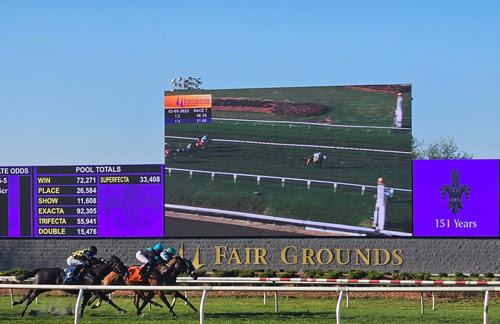 The Thoroughbred Owners and Breeders Association is hosting a Claiming Seminar on Saturday, December 2 at Fair Grounds Race Course & Slots in New Orleans, Louisiana. The morning seminar is strategically positioned on the day of the 25th Claiming Crown, an event that will feature eight races totaling $1 million in base purses, headlined by the $200,000 Claiming Crown Jewel.


Former HBPA Prez On 5th Circuit Appeal: ‘No Matter The Result’ Both Sides Expect Supreme Court To Decide HISA’S Fate

U.S. Supreme Court | Getty Images
By T. D. Thornton
Leroy Gessmann, who served as president of the National Horsemen’s Benevolent and Protective Association (HBPA) from 2015 to 2021 and currently works as the Arizona HBPA’s executive director, told commissioners at the Arizona Racing Commission (AZRC) meeting Thursday that regardless of the decision gets handed down by the United States Court of Appeals for the Fifth Circuit, both the HBPA and its opponents in a 2 1/2-year-old lawsuit to nullify the Horseracing and Safety Integrity Act (HISA) agree that the nation’s highest court will eventually have to be called upon to settle the matter.
Gessmann spoke in the wake of Oct. 4 oral arguments in the Fifth Circuit case that pits the HBPA and 12 of its affiliates against the HISA Authority and the Federal Trade Commission. On May 4, a lower court deemed that the now-in-effect version of HISA is indeed constitutional because a 2022 rewrite of the law fixed constitutionality problems the Fifth Circuit had identified. Shortly after that lower court’s ruling came out in the spring, the HBPA plaintiffs then swiftly filed for another appeal back to the Fifth Circuit, which agreed to hear the case on an “expedited” basis.
National HBPA distributes Information About the Merck Banamine Recall
|
|||||||||||||||||
|
|||||||||||||||||
|
|||||||||||||||||
|
HIWU Launches Mobile App; Substance Lookup Tool and Educational Resources Among Key Features
|
|||||||||||||||||
|
|||||||||||||||||
|
|||||||||||||||||
|
Make Your Horses Eligible for the December 2 Claiming Crown at Fair Grounds
|
||||||||||||||||||||||||
|
||||||||||||||||||||||||
|
HBPA Groups Again Appeal HISA Ruling to Fifth Circuit
Appeal follows denial of HBPA’s constitutional claims, injunction motion.
For the second time the Fifth Circuit Court of Appeals will consider the constitutionality of the Horseracing Integrity and Safety Act after a federal judge shot down efforts by the National Horsemen’s Benevolent and Protective Association, as well as state and local HBPA affiliates, to derail the legislation.
On May 17 the HBPAs filed a notice of appeal after multiple rulings adverse to its legal efforts issued by federal judge James W. Hendrix in United States District Court for the Northern District of Texas.
The case first came before Hendrix last year. He decided HISA was constitutional, but a Fifth Circuit panel reversed the ruling and declared HISA facially unconstitutional for failing to grant sufficient power to the Federal Trade Commission to oversee the Horseracing Integrity and Safety Authority. The authority is a private corporation formed to regulate the horse racing industry for compliance with nationwide safety and medication rules.
$1 million Claiming Crown set for Dec. 2 at Fair Grounds
|
|
|


Texas judge hears evidence, arguments in HBPA’s HISA suit
|
|
Kentucky HBPA’s Hiles: We Don’t Apologize for Speaking Out About HISA’s flaws
By Rick Hiles
Anthony Manganaro should get his facts straight before running his mouth.
His attack on the National HBPA and its affiliates is as inaccurate as it is unfair and shows a lack of understanding of the industry.
Let’s get something straight about the National HBPA’s cost of litigating the Horseracing Integrity & Safety Act: The Liberty Justice Center so believes that HISA is unconstitutional that the non-profit is handling the case pro bono, and if Mr. Manganaro ever read on the subject, he would have known that fact.
The HBPA is fighting the right fight and we have every expectation of winning. But even should we lose in the courts, the efforts of the National HBPA, many individual affiliates including Kentucky, four state racing commissions, the United States Trotting Association, several states’ attorneys general and others who have joined in the suits already have forced the HISA Authority corporation to make substantial improvements. In getting a so-called legislative “fix,” HISA and the Federal Trade Commission tacitly acknowledged the original enabling legislation was legally-challenged.
This all could have been avoided had the largest thoroughbred horsemen’s association and the Association of Racing Commissioners International been invited to the table to create a true path forward to improving horse racing. Instead, the powerful and well-financed minority backing HISA opted for class warfare.
Unlike the HISA corporation, the National HBPA and its affiliates have boards elected by their members. The HBPA is proud that our members participate in all levels of racing, not just the 1 percent at the top end. Any action taken by the HBPA is at the directive of the duly elected HBPA board.
Every day we hear from horsemen, too afraid to speak out themselves, thanking us for putting the spotlight on flawed legislation that led to a flawed organization. We believe a sign of our widespread support is the 1,500 participants from every racing jurisdiction who signed an open letter by trainers Wesley Ward and Larry Rivelli advocating for meaningful change and that HISA was fatally flawed.
We believe HISA’s Horsemen’s Advisory Group, which includes National HBPA President Doug Daniels DVM, was only formed in response to the HBPA pointing out the lack of knowledgeable people in creating rules and policy.
The National HBPA was calling for uniformity of regulations and drug and medication policy long before The Jockey Club began its push for federal legislation. We also were calling for uniform testing and more resources for racing surface safety years before Santa Anita’s rash of breakdowns. We have always called for cheaters to be handed stiff penalties. However, this being America, we also believe everyone is entitled to due process.
No one benefits from change just for change’s sake while ignoring science.
We don’t apologize for insisting any federal legislation governing horse racing be lawful. We don’t apologize for doing our due diligence so that rules-offenders are properly punished and don’t get off because they were sanctioned under an unconstitutional law.
We don’t apologize for demanding HISA actually be transparent, instead of simply tossing around the word. For instance, the people paying the freight – which most likely will fall on horse owners — have every right to know the salaries of HISA staff and consultants. But HISA refuses to make them public, hiding behind being a private organization.
We don’t apologize for pointing out when new rules rubber-stamped by the FTC are not in horses’ best interest.
We don’t apologize for questioning a largely duplicative bureaucracy whose burdensome price tag will threaten the financial viability of some small and medium-sized tracks and force trainers and owners out of business.
We don’t apologize for wanting to know who tabbed the nominating committee that in turn tabbed the HISA board, whose terms match that of Supreme Court Justices – meaning for life.
And we sure don’t apologize for speaking out and standing up to bullies such as Manganaro.
Manganaro is the same guy who tried to restructure the Thoroughbred Owners and Breeders Association. He’s the same guy who tried to destroy the Kentucky HBPA and the Kentucky Thoroughbred Association, calling for a new organization that would have only billionaires on the board.
Manganaro is correct about one thing: the Interstate Horse Racing Act of 1978 indeed requires the consent of horsemen before tracks can export the betting signal on the horsemen’s property – their horses – to other states. That’s how it should be, and Congress agreed.
Manganaro seems to think we should stay quiet like good little boys and girls at the kiddie table instead of standing up for what’s right. By speaking out, we have forced HISA to get better, though fatal flaws remain. We will continue to do so, and HISA will pay attention because they know the National HBPA, its affiliates and a few dozen Senators and Congressmen are watching them like hawks.
Rick Hiles is the longtime president of the Kentucky HBPA and the First Vice President of the National HBPA.
HBPA Conference: Three Trainers Express HISA Concerns

Trainers Talk (from left): Jason Barkley, Ron Faucheux, Bret Calhoun and National HBPA CEO Eric Hamelback. Photo by Denis Blake/National HBPA
The 2023 National HBPA Annual Conference closed with a lively discussion with three prominent horsemen who questioned the need, validity and overreach of federal legislation pitched as the so-called savior of racing while the industry heads into a challenging economic and logistical future.
Bret Calhoun, Ron Faucheux and Jason Barkley participated in the Trainer’s Talk panel moderated by multiple Eclipse Award-winning journalist and media specialist Jennie Rees and talked about everything from the Horseracing Integrity and Safety Authority, challenges facing small to mid-sized stables, finding and keeping help and what gives them motivation in spite of all of racing’s uncertainties.
HISA dominated the discussion – as it did much of the conference this week at The Hotel Monteleone in New Orleans – and the trio pulled no punches when it came to the controversial entity.
“The whole thing is a façade. It’s been all smoke and mirrors,” said Calhoun, a member of the Louisiana HBPA board who also maintains strings in Kentucky and Texas. “They sold this thing as the safety of the horse. It’s absolutely not about safety of horse. It’s a few people, with self-interest and they have their own personal agenda.
“If it was all about the horse we’d be spending a lot more time on racing surfaces. We could probably cure about 50 to 75 percent of the injuries if we had somebody overseeing surfaces on a daily, weekly basis. Not somebody taking soil samples before the meet and at the end of the meet and calling it good.
“They’ve been taking away certain medications, therapy machines, things that are truly beneficial. They’re having the opposite effect of what they’re saying … safety of the horse and rider. They’re doing absolutely the opposite. Like I said, it’s all a façade.”
Faucheux, also a member of the Louisiana HBPA board and just two back of the leader on the Fair Grounds’ leading trainer’s list that he topped for the 2021-2022 meeting, conditions a stable of about 60 horses and hasn’t left his native state since HISA rules went into effect last summer.
“I haven’t signed up and I won’t sign up. I’ll get out of training if I have to sign up,” Faucheux said. “A stable like mine, 55-, 60-horse stable, I couldn’t afford the cost of having to hire somebody to do the paperwork for me. The added expenses of it all, it wouldn’t work financially for me. It’s a struggle to get by the last couple years. Feed costs have gone up 50 percent, hay, shavings, it doesn’t make financial sense for a trainer in Louisiana year-round to sign up and have to take on all those added fees because right now we’re barely making it as it is.”
Barkley maintains a stable of about 30 horses based at Fair Grounds and Oaklawn Park in the winter and in Kentucky the majority of the year. A member of the Kentucky HBPA board and a third-generation horseman, Barkley said he feels the impact of the regulations already and only sees them as potential obstacles for trainers hoping to grow their stables.
“A lot of my smaller clients they don’t want to pay the added cost of a per-start fee, the extra vet checks, and all the added fees they want to put on us,” Barkley said. “There’s added costs and the time to do all the work. Between me and my main assistant, who is my wife, Shelbi, we do the extra paperwork, keeping track of everything. We already kept track of what every horse got every day but to then have to put it into files, that doubles the workload. That is time taken away from actually working with your horses, which is what you should really be focused on.”
Rees steered the discussion away from HISA at several points but the new laws found a way back, much like many of the prior panels during the week-long conference in the French Quarter.
“What is HISA’s ultimate goal? I’m sure there is one,” Faucheux said. “To me it looks like about half the racetracks to close down and about half the people to get out of it. And I think that’s what will eventually happen if it’s implemented across the country, over the span of several years.”
“These are people sitting in offices and coming up with these rules and regulations that really aren’t for the benefit of the horse, the riders, the owner, the industry as a whole,” Calhoun said. “It’s not good for the industry. … To get this bill, to attach it to a Covid bill, an emergency bill, that’s something that should be stopped with every instance. No emergency bill should ever have anything attached to it. That’s how they got this going. … That’s how Congress works, unfortunately.”
The trainers also agreed on that another major challenge they face – finding and keeping good help. That situation was difficult well before the pandemic and exacerbated since.
“I’ve got a family of like 15 that work for me,” Barkley said, joking that his 2-year-old daughter was back at the barn mixing feed while he attended the panel. “A lot of it’s you get good people that know good people, and hopefully keep pulling them in that way.”
Calhoun called it an “impossible task” he and his colleagues face nationwide.
“Since Covid, there’s now a reduced number of employees that you can find,” Calhoun said. “That’s part of issue. Then you add HISA costs to this and our labor costs are through the roof. It’s the highest bidder and eventually you’re losing significant money to stay in business.”
The trainers still possess great passion for racing – and the horse – despite all the challenges lumped on them from the boardrooms and from lingering economic issues stemming from the pandemic.
“When I realized quite early that I wasn’t going to be the quarterback for the New Orleans Saints I said I want to do this,” Faucheux said. “This is probably second to that. But all jokes aside, I love it. I love being a trainer. I love my horses, the staff and I love the lifestyle. … There’s a lot that goes along with it that can sour you up. Recently, with HISA brought about, and the price increases of everything, it makes it hard to go on and do it the way you want to do it.”
Calhoun acknowledged that winning 20 percent of the time – which very likely might get a trainer consideration for the Hall of Fame over a long career – still meant losing bunches of races along the way. But it’s the winning that makes it worth it, he said.
“That’s what drives me,” Calhoun said. “And the horse is what makes you want to get up every morning and do it.”
Barkley agreed, and echoed sentiments of one of his colleagues with a large stable spread out in multiple states.
“I just love the action. It’s all fun to me,” Barkley said. “I heard Mike Maker say, ‘they’ll run out of stalls before I run out of horses,’ and that’s kind of how I think. Bring them on, we’ll fight the fight as well as we can for as long as we can. … It’s all fun for me.”
Fixed odds on racing at U.S. sports books and more?
Albeit not as dramatically as sports betting is sweeping the country, fixed-odds wagering on horse racing is coming to America and should be embraced as well as understood by horsemen.
That was the advice of two heads of major horse-racing content distributors and two executive directors of horsemen’s associations. They spoke on a closing-day panel at the National Horsemen’s Benevolent & Protective Association conference, which was held in conjunction with the Association of Racing Commissioners International at the Hotel Monteleone.
The panelists addressed both the growth of U.S. tracks sending their race product to legal bookmakers overseas and the possibilities and challenges of introducing bookmaker-style fixed odds as a wagering option at U.S. tracks, whether at the actual track, another bricks-and-mortar facility or online.
“We’ve really had a mantra to educate our members on what’s coming,” said National HBPA CEO Hamelback when introducing what has become an annual panel. “Whatever you decide as a state — to bring it in, not to bring it in, or if you’re fortunate enough to have a sports-wagering license — I believe sports wagering and fixed odds are in our future. But it’s up to us to continue to educate everyone properly on the pros, the cons and the nuances of what’s going on.”
Panel moderator Michele Fischer offered some stats: A total of $44.3 billion globally was wagered in 2022 through legalized fixed odds on horse racing. That’s led by Australia at $19.1 billion and the United Kingdom at $12.9 billion. Sports betting in the United Stakes is predicted to gross $10.2 billion this year and be up to $16 billion in 2026, according to Fischer’s research. The point being: Fixed odds on horse racing is popular around the world, and American tracks need to get into the sports-book action igniting around the country.
American horse racing for more than a century has been based on pari-mutuel wagering — where players are betting against each other and final odds aren’t determined until after wagering closes on a race. With fixed odds betting, players can lock into a price and the competition is against the house, not only for sports betting but for wagering on horses.
Sports betting is now being offered in some form in 36 states and Washington D.C., with the enabling legislation in place in several others and before lawmakers in a few more. Presently only New Jersey and Colorado have implemented fixed-odds wagering on horse racing.
Offering the same structure as sports betting, with its fixed odds, has the potential to grow horse racing’s market, the panelists agreed. But they stressed it will take some time for the industry to reap the full benefits, with the betting public potentially reacting in unexpected ways.
“There are ways in which a low-percentage margin can turn into huge amounts of profitability. But to believe you’re going to know exactly what is happening from Day One is completely unrealistic,” advised Richard Ames, the CEO at the British-based Sports Information Services (SIS) and president of SIS Content Services, the largest horse-racing content supplier to global bookmakers/sports books. “Starting is important. Transparency of the data is important, and then move forward. Not having long-term deals on Day One, or having some flexibility to adapt to the way consumers want to play, that’s the way to approach this challenge.”
The risk of cannibalizing the existing pari-mutuel pools if fixed odds are also offered was discussed at length.
“I think everybody in this room agrees we want to get our racing product in front of the sportsbook customers,” said Scott Daruty, president of U.S.-based Monarch Content Management, the simulcast purchase and sales agent for more than a dozen premier North American tracks. “…. But it’s important that we introduce it in a way that doesn’t hurt our pari-mutuel pools. We have some pretty definitive thoughts on what that means. First and foremost: we believe fixed-odds wagering should be offered on a win and place basis only.”
That brought pushback from Ames, a former executive with Ladbrokes, a market leader in retail bookmaking.
“Going in (saying) we’re going to restrict what you can do misses the point in terms of the sports books’ attitude to horse racing,” Ames said. “We have to remember these sports books are generating huge amounts of revenue, and horse racing comes in late to the party. Those sports books need to want to do it…. It will cost them money to get ready to be able to bring these props into the market, and those props will be competing against other sports. I do recognize the challenge around cannibalization. But I think going into sportsbooks with the attitude, ‘we’ll restrict you from the beginning’ is not going to get them to buy into the production and do it in a way that will maximize the profitability for all.”
Dave Basler, Executive Director of the Ohio HBPA, and Louisiana HBPA Executive Director Ed Fenasci stressed that horsemen need to be informed and part of the decision-making process.
“There’s a strong possibility (fixed odds) could bring a lot more volume in, and any cannibalization is minimal because it brings additional pari-mutuel wagering in through the new volume,” Basler said. “But I don’t know…. If you’re doing $250,000 a day in total handle, you don’t have a lot of downside to trying fixed odds. It’s going to be a different equation to what deal you approve than a Santa Anita that’s betting $10-12 million a day, a lot of it on track.”
Ames and Daruty differed on what deal structure would most benefit American tracks and horsemen. Ames said the industry seems to be settling on a set-up based on a percentage of the revenue, whether on the gross or net.
“Either way, the bookmaker pays a percentage share of the revenue they take” as opposed to a flat per-card fee, he said. “The reason we would generally favor that is because it would mean everybody has the same interest: how do we maximize the value of the content?
“One of the challenges with the economics of fixed-odds betting is that the numbers look quite different than they do on pari-mutuel. The idea of ‘takeout’ in the teens or 20 cents versus the expectation of a share of the turnover (betting) that might be 2 percent. Those numbers look very different. It doesn’t mean they can’t deliver more money in the long run, but in the short run they’re quite difficult to get your head around. It needs to be incremental. I’d recommend in general having a shared approach with the bookmaker. That means everybody is talking the same language.”
Daruty offered a different perspective. “I think it’s important that you don’t get too caught up in taking a little tiny piece because it’s going to be a big, big pot,” he said. “That’s great, and maybe you do in a new market. But again, if you’re cannibalizing your parimutuel pools, you end up losing money in the long run.
“What we want to make sure never happens is our horse racing is used as a loss-leader product. You take a horse that should be 5-1, and the sports books are competing so one book offers 6-1 and one offers 7-1. Ultimately they’re not making any money on that race, but they’re using it to attract customers. And guess what? You get a share of their profit on that, which is zero. All you’ve done is move people out of your parimutuel pools and into fixed odds.”
Fischer, a Louisville-based industry consultant who serves as vice president of SIS Content Services, asked why not just add pari-mutuel wagering to U.S. sportsbooks? Daruty said that might be the answer.
Daruty — whose corporate ownership includes Santa Anita and Gulfstream Park in its racetrack portfolio — said the biggest form of betting in the United States is the lottery “which is a form of pari-mutuel wagering.
“I’m not saying we’re opposed to fixed-odds racing, but we look at it very cautiously and very carefully,” he said. “I think if there’s one thing we’d all agree is that we need to get our racing product in front of all these sports-betting customers. Our company is very open to fixed odds, but only if we can do it in a controlled, measured way that doesn’t undercut our business.”
Back to Ames: “Everything going on in those sports books is fixed odds. The idea you will try to force those consumers, who are a big incremental opportunity, to have to learn to bet in a different way, that seems to me to be counterintuitive… I think to really take the opportunity of these sports books there has to be a fixed-odds solution. That doesn’t mean there can’t be a parimutuel solution as well.”
Meanwhile, the American racing product is coveted by content distributors because they are trying to provide betting products around the clock to their global clients.
Daruty said his company’s initial foray into the international market was “an utter failure.” Success came when they started offering the odds to the overseas books and tailoring the packaging to individual markets overseas. That included hiring a team to call the races in the local language on a second audio feed.
Fenesci said he was surprised to find out last summer that Louisiana Downs’ best overseas outlet was Spain, saying, “When I’m looking at these contracts, it was very important for horsemen to get the feedback exactly where the product is going and what is the volume that is being generated in those markets, so that you can continually evaluate and make good decisions.”
The Ohio and Louisiana horsemen have been at the forefront of ensuring their purses benefit from overseas betting on their races.
“It is imperative that your product get into as many bookshops as you can,” Fenasci said. “…. When you’re dealing with distribution, you want to work with reputable companies that have the relationships around the world to get your content the widest distribution. We’ve had long-term agreements with our racetracks that our purses will share in revenue generated directly from horse racing.”
Basler said the Ohio horsemen handle it through their domestic simulcast approvals. “They are very specific that in order to sell U.S. content within the U.S. or outside the U.S., all sites have to be disclosed to us and approved and we have to receive our share of that revenue,” he said.
Honoring Don Stemmans, Claiming Horse of the Year Kitodan
Earlier at the conference, Don Stemmans, whose family has raced horses in south Louisiana for eight generations, was honored Wednesday as an HBPA Living Legend, a distinction that in its third year has fast become a tradition. Stemmans and his wife, Janet, opened their first tack shop in 1968. His capacities in racing include being a starter at Evangeline Downs and serving on the board of the Louisiana Thoroughbred Breeders Association for more than 20 years. He also would shoe horses on his days off from working on oil rigs. Louisiana HBPA board member Kevin Delahoussaye feted Stemmans as part of a luncheon program. Now a banker, Delahoussaye recalled his first line of credit coming at age 13 from “Mr. Don” to buy tack for a racehorse.
At Tuesday’s luncheon, Ellis Park-based Kitodan, who went from being claimed twice to winning Kentucky Downs’ $750,000 (G3) Big Ass Fans Dueling Grounds Derby, was honored as the 2022 National Claiming Horse of the Year. Doug Miller, who owns Kitodan with Bill Wargel and trainer Eric Foster, was on hand to accept the award.
You must be logged in to post a comment.